An Exploration of the United Nations Office at Geneva
By Molly James Marleigh
On June 4th 2026, a group of students were given the opportunity to attend a well-prepared itinerary of meetings at the United Nations Office in Geneva (UNOG) accompanied by Professor Henry Lovat. This opportunity was primarily for students on the International Law and International Security LLM, but was kindly opened up for students on other LLM programmes. During this trip, students had the opportunity to receive a short tour of the UNOG, followed by meetings with the UNHCR, OHCHR, and UNIDIR in the UNOG room S4, a short and snappy lunch break before finishing up with Coffee at the Musée International de la Croix Rouge et du Croissant Rouge (International Museum of the Red Cross and Red Crescent) HINIVUU Café for a final Q&A-style meeting with the ICRC. To say we were lucky is a grave understatement. We all have great gratitude towards learning and teaching administrator (law) Emma Burden and Professor Lovat for making this trip possible – as well as appreciation for the members of the organisations we had the privilege to talk to.
I. The United Nations Office at Geneva: A Brief Introductory Tour
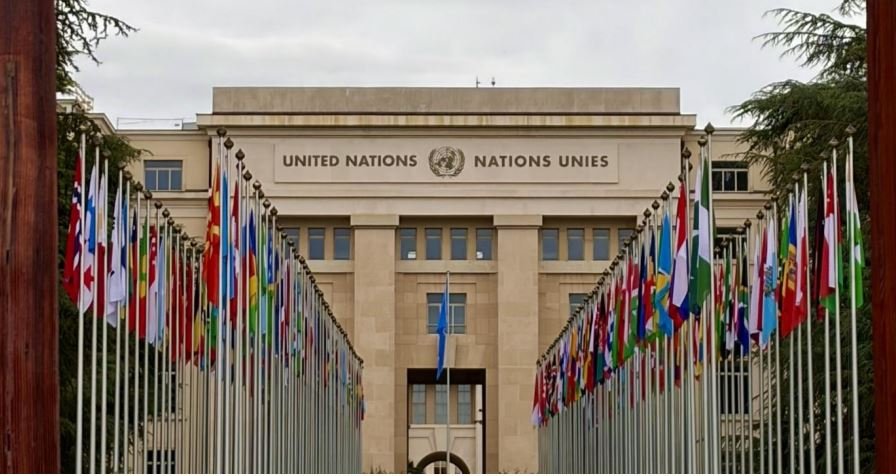
Our wonderful insight into the daily operations of the UNOG started with a tour from Michael Schoiswohl. Once we went through the UNOG's intense security at the Pregny Gate entrance at 08:45 CEST, Schoiswohl led us through numerous rooms of the main UNOG building, including a room which contained artwork donated by Hungary, and the Assembly Hall! The sheer amount of history contained within each room of the UNOG is absolutely remarkable – not to mention a true display of the international field to which the UN operates. Schoiswohl combined witty jokes with fun trivia to really help get the students settled in, ease any nerves, and start the trip on a high note. The core principle that Schoiswohl emphasised was the fact that the UN operates as a collective, almost like a family. Each organisation is tied together in some way, shape or form, but at the centre of it all, each organisation works together to achieve the premises of the UN stated in Article 1 of the United Nations Charter: to maintain international peace, and security. Like his fellow speakers, Schoiswohl was more than happy to answer insightful, thoughtprovoking questions from the students as well as discuss his unique career path and what led him to become Senior Legal Advisor at UNOG. Speaking with students afterwards, Schoiswohl's tour of the UNOG and welcome meeting was regarded as one of the most insightful events of the day, during which the students managed to take many photos and stories to brag about for years to come.
II. Solution, Protection, and Assistance: The Core Values of the United Nations High Commissioner for Refugees (UNHCR)
Following our welcome introduction with Schoiswohl, our first meeting commenced. Lance Lorenz Bartholomeusz, General Counsel and Head of the Legal Affairs Service at UNHCR, was joined by Assistant General Counsel, and Legal Affairs Service at UNHCR Philomena Cleobury and Maximilian Zuber. Bartholomeusz started the meeting by discussing the history of the UNHCR, and its relevance before diving into the core principles of the UNHCR, which are Solution, Protection, and Assistance. To understand these, it is important to note that an emergency, as defined by the UNHCR, is any humanitarian crisis which has either caused, or threatens to cause, new forced displacement, loss of life, or other serious harm OR which demands exceptional measures for a predictable and effective response beyond current capacities. The role of the UNHCR includes monitoring, reporting and intervening on legal matters around asylum, RSD, statelessness and human rights, as well as supporting the integration of people that they work with and for. One of the current developments in this is the Cash Assistance Journey, in which cash is implemented to provide aid to refugees with a sense of dignity, humanity, and choice.
III. El Salvador, Ecuador, and Haiti: Key Case Studies in the Office of the United Nations High Commissioner for Human Rights (OHCHR)
Matthias Behnke, Regional Director for the Americas in the OHCHR, was another student favourite. His sense of humour and pragmatic – slightly pessimistic – view of the world made a strong impact on the students. With an impressive background in international law, Behnke was met with loads of student questions – all of which he happily answered to the best of his ability. He emphasised the main challenge of the OHCHR, how the organisation can engage with States by simultaneously taking their security issues seriously, while also helping them conduct their work in a way which complements and complies with international human rights law. Behnke discussed three key case studies with us, El Salvador, Ecuador, and Haiti, to demonstrate the importance of the role of the OHCHR.
IV. Artificial Intelligence, Security, and Ethics in the United Nations Institute for Disarmament Research (UNIDIR)
From a more glass-half-full perspective, Fabian Halfpap gave us insights into the world of international security, specifically UNIDIR. UNIDIR is an autonomous institution within the UN family which conducts independent research on pressing global challenges in relation to arms control and international security. This research spans a vast range, starting with the Middle East and spanning beyond Earth into the realm of Outer Space. In an era of uncertainty, UNIDIR is committed to shaping resources to anticipate challenges ahead. A key issue-specific project which Halfpap discussed was the use of AI in all areas of weapons with negative and positive impacts and opportunities, as well as UNIDIR’s goal to create a Weapons of Mass Destruction (WMD) free zone in the Middle East. According to Halfpap, all UN Member States support UNIDIR, including the P5. With over one-hundred and fifty annual events and over twenty thousand participants, it is clear that UNIDIR is a thriving organisation which will not disappear any time soon. V. A Short and Snappy Break As a ‘reward’ following the first three meetings, students were taken down to the UNOG cafeteria with Schoiwohl and Professor Lovat, in which their long-rooted friendship truly shone. The cafeteria was filled with many options from a salad bar to pizza and a full vegetarian section. However, as with much of Geneva, the cafeteria certainly was not on the cheap side of the scale. I would recommend that future students take in a packed lunch, or risk spending a small fortune on a meal. Thankfully, to my delight, Professor Lovat allowed us some time in the UNOG gift shop before departing, in which I would highly recommend investing in a pink, green, yellow, or blue copy of the Charter of the United Nations. Not only will it free up laptop space and serve as memorabilia for the trip, but it also looks fabulous on your bookshelf!
VI. Coffee, Contemplation, and a Q&A Session with the International Committee of the Red Cross (ICRC)
The Musée International de la Croix Rouge et du Croissant Rouge is an absolutely beautiful building right across from the UNOG. If ever the chance arises, I would highly recommend popping in to grab a coffee at the HINVUU Café; the staff were delightful, and the drinks were outstanding and very reasonably priced (for reference, 5.5 CHF for an Oat Vanilla Latte!). While situated within this café, we had the opportunity to meet with three members of the ICRC, including two trainees – one of whom had only been working with the ICRC for four days! It was a pleasure to be able to discuss current international issues with the members of the ICRC, and learn how the trainees got their positions and how we might be able to enter the vast world of humanitarian law ourselves. Learning the ways in which the ICRC interacts and cooperates with the UN as a neutral organisation with the common goal of preventing armed conflict was a perfect insight to wrap up our day. Max Pushkin, Mary Olajide and Etienne Kuster truly captured the students' attention after such a long day of meetings, and helped open up some windows for future endeavours.
VII. A Drink to Commemorate: A Social Gathering and Concluding Thoughts
To conclude our adventure, Professor Lovat asked me to invite everyone to a social gathering at Les 5 Portes for informative drinks and discussions. We were joined by more than half of our group a few hours after our trip to the UN concluded. Professor Lovat was a joy to chat to, he enquired about our opinions on the semester and seemed genuinely interested in our LLM journeys, our experiences in Geneva as a whole, and what our next steps to reach our dreams and aspirations may be. Overall, our trip to Geneva was a remarkable success. My final piece of advice to future students embarking on similar trips is to always ensure you arrive at least ten minutes early, and be prepared with snacks (if the institution allows for it)!